The fastest growing contact centres only have five agents
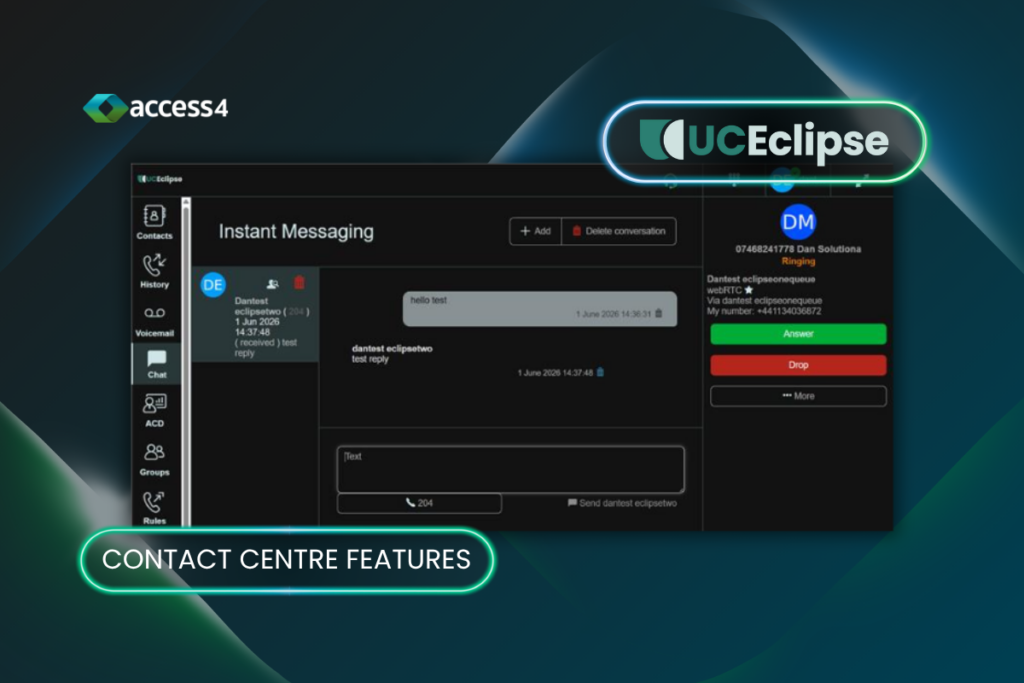
In the last article, we looked at how UCEclipse gives every device the same identity. This article covers what happens once the call actually lands. Most businesses don’t need a fifty-agent contact centre. They need calls answered properly: routed to the right person, handled fairly in a queue, and never left to simply ring out. That’s what most partner conversations focus on now. Five to eight seat teams want omnichannel messaging and proper call routing. They don’t want a standalone contact centre platform, and everything that comes with buying one.
UCEclipse gives partners exactly that, built into the unified communications platform a business already uses. The data backs up what partners hear on the ground. Cavell’s contact centre research found that deployments of one to five agents make up one of the fastest growing segments in the market. Driven by demand for what it calls “contact centre lite.”
How UCEclipse removes the trade-off
Advanced call routing has traditionally meant a trade-off. Partners get the features they need, but also a platform that demands specialist configuration and ongoing IT support. UCEclipse removes that trade-off. At the front end, the IVR Visual Editor gives partners drag and drop control over call flows. Client calls reach the right department without a developer in the loop.
Behind it all, sits a comprehensive ACD Group feature set. Covering everything from welcome and queue workflows through to distribution logic, exit rules, scheduling and messaging handling. Worth knowing when you’re scoping a deal: this is exactly what the Professional plan is for. Lite and Essentials cover core calling, apps and personal queuing. ACD groups, advanced queueing, callback and skill based distribution all sit in Professional. That makes it a clean upsell path rather than a hard sell. Customers only pay for contact centre depth once they, or the end users they support, actually need it.
What happens once call volumes grow?
That depth matters once call volumes grow. Supervisors can configure preferred agent distribution, ringing and unreachable agent timeouts. Along with queue position and ETA announcements, and multiple breakout options, including voicemail breakout and dial-zero to a nominated destination. Scheduling controls handle opening and closing hours automatically, with closure announcements and forwarding rules for out of hours calls. Messaging follows the same approach: auto-replies for queued, closed or full conversations, maximum handling times, and conversation limits per operator.
Why call-back beats a blunt redial loop
Callback is where UCEclipse goes further than most unified communications platforms. When a queue is full, or a caller hits the maximum wait time, UCEclipse can offer them a callback instead. Partners can configure retry attempts, ringing timeouts, and operator feedback windows.
Callers get SMS notifications when they register and when the callback succeeds. Re-injection logic even pauses and resumes callback attempts around group closures, so nothing gets lost overnight. This is proper ACD functionality handling the follow-up, not a blunt auto-redial loop hoping the caller picks up.
It solves a problem that’s measurably real: UK research from MaxContact found that 55% of consumers hang up when they’re kept waiting too long, making it the single biggest reason people abandon a call altogether. Supervisors get real-time visibility to match. Wallboards and historical reporting show exactly how calls and queues are performing, so teams can reallocate staff during peak periods and respond to demand as it happens, rather than after the fact. It’s the kind of oversight platforms costing far more usually keep for themselves.
In the field
A professional services firm uses the IVR Visual Editor to route client calls to the right department, with supervisors adjusting queues during peak periods to protect service levels. A distributed support team monitors queue activity in real time and reallocates staff during busy periods, cutting wait times without adding headcount. For the end customer, that depth shows up in ways that are easy to feel and hard to miss: fewer abandoned calls, shorter waits, and a callback option instead of a dropped connection when things get busy.
Queue position updates tell customers where they stand, rather than leaving them guessing. If the wait runs too long, they get offered a way out that doesn’t cost them their place. None of that requires a customer, or the people they serve, to know or care what’s happening behind the scenes. It just means the call gets handled properly.
Most alternatives force a choice between basic unified communications and a full contact centre platform, with a steep jump in cost and complexity in between. UCEclipse sits in that gap and grows with the customer, rather than forcing a rip and replace. As a business scales past twenty or thirty seats and starts asking for more, UCEclipse bands up towards fuller contact centre functionality on the same foundation.
No second platform, no starting over. The result is call handling that looks and performs like a contact centre platform, minus the specialist setup that usually comes with one, and minus the frustration customers usually associate with calling one. Next up, we’ll look at what happens when UCEclipse sits alongside the rest of the Access4 portfolio, and why that combination is where things get really interesting for partners.
Find out more about UCEclipse HERE