Every channel partner has heard the AI pitch by now. What separates the products worth their attention from the noise is simple. Does it change what you can sell, and how you sell it?
For Access4 partners, AIX Voice Assistant answers that question with a genuinely different kind of conversation.
Beyond reliability and cost
Voice has always been sold on two things: a solid line that does not drop calls, and a price that does not cost the earth. AIX Voice Assistant moves that conversation somewhere more valuable.
It shifts the focus to what a customer’s business actually feels when someone rings in. Are calls handled quickly? Is routine information available without a person having to go and fetch it? Are staff spending their day on calls that need real judgement, rather than being pulled under by ones that do not?
AIX comes as a result of growing noise around AI, backed by ongoing research by Cavell in their 2026 report from the Nexus 2026 sumit, and Agentic AI in Customer Experience gap.
What AIX Voice Assistant actually does
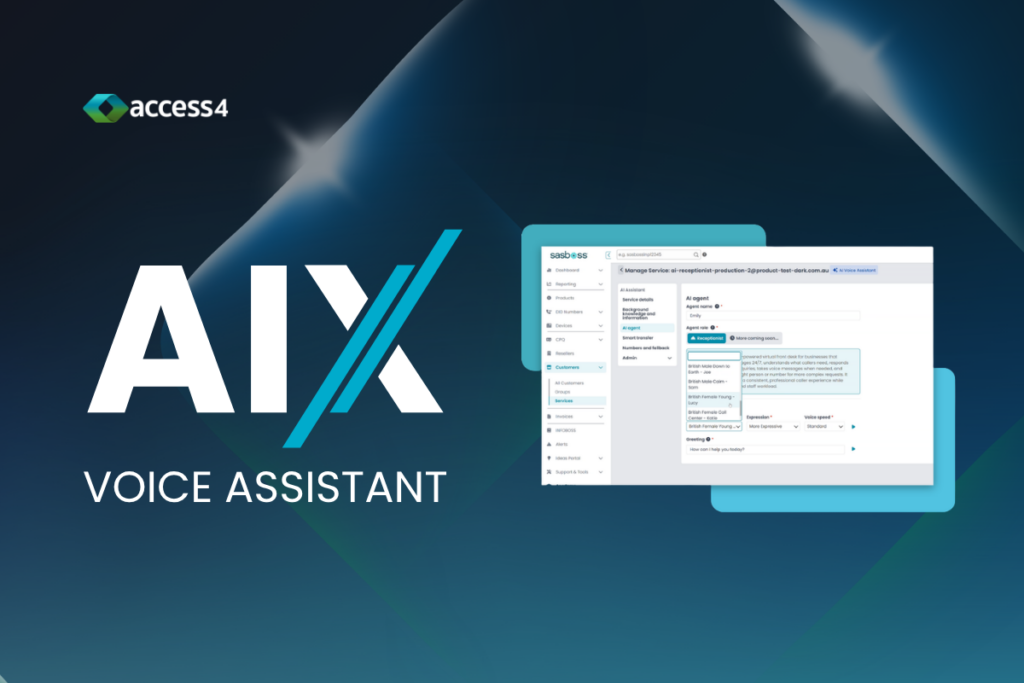
AIX Voice Assistant answers calls when a customer’s team is unavailable, at any time of day. It holds a natural conversation rather than routing callers through a phone menu. Straightforward queries get resolved immediately. More complex calls are transferred directly to a person. It stays on topic and in context throughout, sticking to what the business has told it to say.
Here’s what comes with it:
- Customisable voice answering, tuned to reflect the business it represents
- Rapid response time, minimising delay between caller and reply
- Smart routing and transfer across UK numbers and international callers
- Post call transcription with sentiment and quality rating
- Guardrails that keep every conversation on topic and on brand
- Self-serve setup, live for a customer in around five minutes
- Fallback redundancy, so calls keep being answered if one path has an issue
Built to be trusted as a front line product
Sean Williams, Access4’s AI Product Manager, is candid about where AIX started. “I inherited an existing proof of concept” he says. “It was great to show off to friends and family. I probably wouldn’t trust it as my front line.”
Getting from there to something a partner could put in front of a paying customer meant rebuilding the architecture around one question. Would it perform as reliably as a person hired to sit in that seat every day?
That discipline shows up in some deliberately un glamorous decisions. Access4 owns and operates its own carriage service rather than relying on a third party. Every recording carries a zero retention policy, with customer data stored locally in dedicated data centres in London and Manchester for UK deployments.
There’s also a dedicated internal effort, effectively a full time job, aimed purely at trying to break the product before anyone else finds the gaps.
The investment behind the AI product
Building AIX this way came at a cost, in the order of one and a half million pounds in headcount and infrastructure. That kind of spend only makes commercial sense at scale.
Spread across roughly 600 partners and 20,000 customers, cost that would be prohibitive for a single partner becomes manageable. It’s the same logic that underpins the wider Access4 platform.
The beta process reinforced the same partner first thinking. It ran as a closed, four week cycle with a small, deliberately demanding group of partners. Several requested changes are already live in production, including the order in which future integration’s get built, prioritised by partner demand rather than internal preference.
AIX is not a finished, static product frozen at launch. It reflects an ongoing philosophy at Access4, where AI capability is built in response to what partners and their customers actually need, tested against real conditions, and refined from there.
An easy conversation to have
AIX Voice Assistant is provisioned through SASBOSS, with billing and support handled through the same platform. Partners are not asking customers to evaluate a new vendor or set up a separate contract. They’re asking them to add a capability through a system they already trust.
That’s a far easier conversation to have, and one channel partners are well placed to lead given how embedded they already are in a customer’s day to day operations. It’s also why so many demonstrations end in an immediate deployment. The technical friction that normally slows a sale down simply isn’t there.
The early numbers back it up. Over 500 calls have been handled and more than 10 hours of live conversation processed in the first month alone, all without a single reported issue.
Sean Williams explains why the product was built this way rather than left for partners to piece together themselves. “What Access4 has built allows partners to specialise in what they specialise in,” he says. “We’ve built something that enables a partner to keep doing what they do, instead of being busy running a product that’s tertiary to their business.”
Who’s getting the most value
The industries showing the strongest early pull aren’t always the obvious ones.
- Not for profits with sharp peaks in call volume
- Fast growing businesses past the 20 to 30 employee mark, where internal processes start to strain
- Wholesale and retail operations fielding high volumes of simple, repetitive queries
- Trade services such as plumbing, HVAC and electrical
- Real estate, hospitality and professional services firms
They share the same pain point: calls coming in when nobody is free to answer them properly. For a receptionist juggling five jobs at once, described in the product’s own positioning as the director of first impressions, AIX Voice Assistant protects that role while freeing it up for work that needs a human touch.
Ready to sell it
Channel partners have every right to expect substance from an AI product, not just a headline. Access4’s approach to AIX Voice Assistant was built around exactly that expectation, and it shows in almost every engineering decision behind it.
A voice assistant built this way is one partners can stand behind with real confidence, built to last rather than built to keep pace with a headline.
Ready to see AIX Voice Assistant for yourself? Book a demo today: